Indigenous Farming · First Nations Australia × Regenerative Science
Nutrient Deficiencies From The Ground Up: Why Soil Health Is Human Health
9 min read
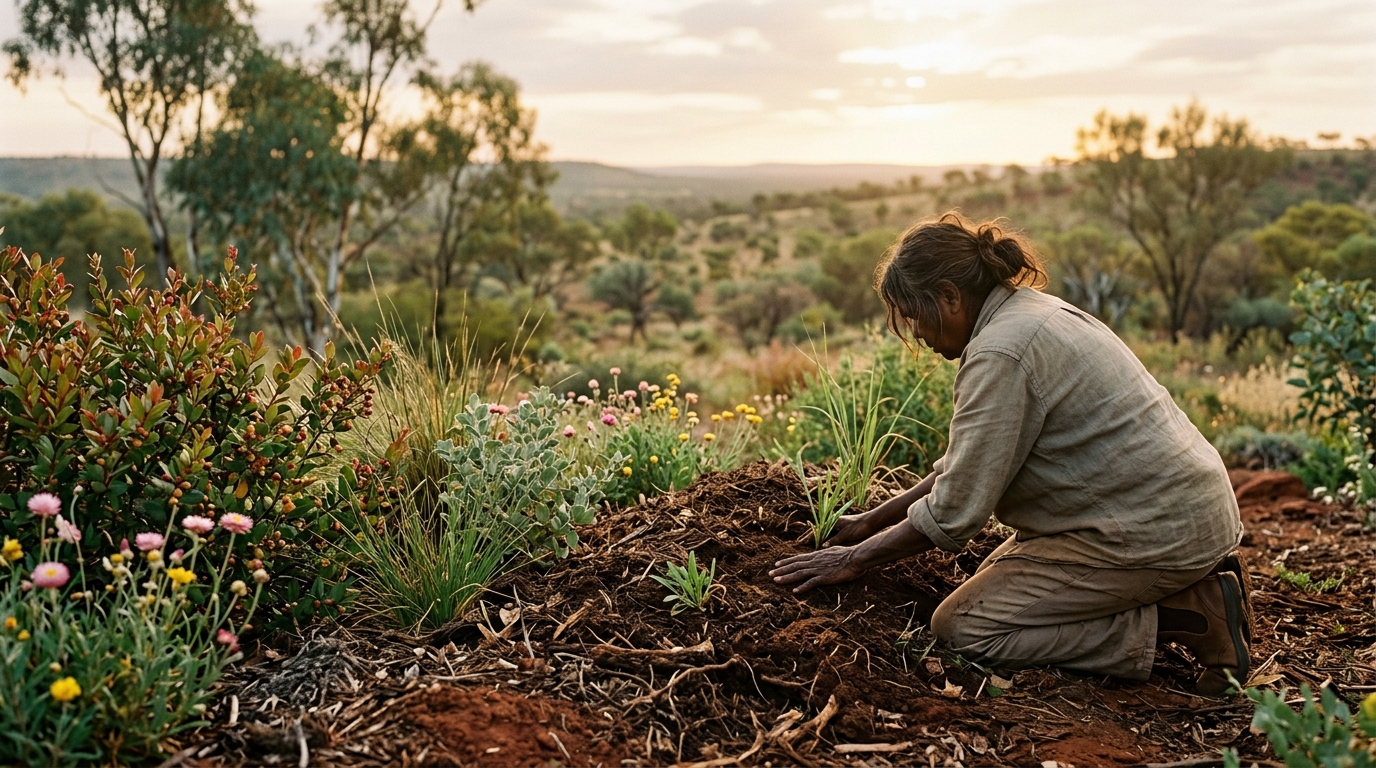
Depleted soils grow depleted food. How caring for Country through regenerative practices restores the mineral foundation of vitality—from microbes to immune resilience.
The conversation about nutrient deficiencies usually begins at the plate—not enough iron, too little magnesium, insufficient zinc. Yet the deeper truth begins metres below, in the living matrix of soil. For tens of thousands of years, First Nations Australians have understood what contemporary soil science is only now quantifying: the health of people is inextricable from the health of Country. When soil is stripped, compacted, or chemically degraded, the cascade of depletion moves upward through every living thing that depends on it—from the smallest soil bacteria to the humans who eat the plants and animals nourished by that ground. Nutrient deficiencies are not merely dietary oversights; they are symptoms of broken relationships with land.
Diets that are balanced in fresh whole foods may, in fact, not be providing sufficient levels of essential minerals. This is largely due to the poor mineral quality of the soil, with a combination of pollutants and continuous cropping deplete the soil and plant foods that are grown on them.
Modern industrial agriculture has prioritised yield over vitality, relying on synthetic fertilisers that replace only a narrow band of macronutrients—typically nitrogen, phosphorus, and potassium—while ignoring the seventy-plus trace minerals that comprise a truly fertile soil ecosystem. The result is food that looks abundant but is biochemically hollow. Studies comparing the nutrient density of crops grown in the 1950s to those grown today reveal declines of twenty to forty percent in minerals like iron, zinc, calcium, and magnesium across staple foods. This is not genetic drift; it is soil exhaustion. Plants can only draw up what the soil contains, and when micronutrient reservoirs are depleted or locked away by compaction and chemical imbalance, even a diverse diet may fail to meet baseline needs. We are, quite literally, eating the ghosts of nutrition.
First Nations ecological knowledge offers a counter-narrative grounded in regeneration rather than extraction. Caring for Country involves practices like cultural burning—low-intensity fire that recycles nutrients, reduces fuel load, and stimulates seed germination—alongside seasonal rotation of harvesting sites to allow landscapes to rest and replenish. These are not passive conservation strategies but active tending relationships that build soil complexity over time. When Country is healthy, it generates abundance: dense root systems hold water and carbon, microbial networks unlock minerals from parent rock, and a diversity of plants contributes varied organic matter that feeds the next cycle. The soil becomes a living bank of bioavailable nutrients, not a spent mine shaft requiring constant external inputs.
Regenerative agroecology applies this same logic through practices like cover cropping, composting, minimal tillage, and integrating livestock in ways that mimic natural grazing patterns. These methods rebuild soil organic matter, which acts as both a sponge for water and a storehouse for minerals. Healthy soil teems with billions of microorganisms per handful—bacteria, fungi, protozoa, nematodes—that form symbiotic partnerships with plant roots, trading nitrogen, phosphorus, and trace elements for sugars the plant photosynthesises. This is the original economic system: reciprocity, not extraction. When we restore this biological activity, the nutrient density of food grown in that soil measurably increases. Tomatoes taste richer because they are richer—in lycopene, in potassium, in the full spectrum of co-factors our bodies recognise as nourishment.
The soil-to-gut continuum extends further still. Emerging research reveals that the diversity of microbes in healthy soil correlates with the diversity of microbes in the human gut when we consume food grown in that soil—especially when we eat it minimally processed, with some of the earth still clinging to root vegetables or foraged greens. These soil-derived organisms colonise our intestines, support immune function, and even synthesise certain B vitamins and vitamin K. Conversely, food grown in sterile, chemically managed soils contributes to the microbial monotony increasingly linked to inflammatory and autoimmune conditions. Caring for the soil microbiome is, quite directly, caring for our own inner ecology.
Australian native foods exemplify the nutrient density possible when plants evolve in relationship with ancient, mineralised soils. Kakadu plum, for instance, contains exponentially more vitamin C than citrus—not because it is genetically engineered, but because it grows in landscapes where Country has been tended for millennia, where fire and rest and biodiversity maintain soil vitality. Wattleseed, bush tomato, and warrigal greens likewise offer concentrated minerals and phytonutrients reflective of their rootedness in living, complex ground. These are not exotic superfoods; they are expressions of what all food could be when soil is honoured as the foundation.
Addressing nutrient deficiencies, then, requires more than supplementation or dietary reshuffling—it demands a return to soil stewardship. Support regenerative farms and First Nations-led land management. Grow your own food in compost-rich soil, even if only in pots. Eat seasonally and locally, choosing produce from living ground over hydroponic or conventionally farmed options when possible. Understand that every bite is a conversation with the earth it came from, and that the depletion or vitality in your body reflects the depletion or vitality in the soil. Nutrient deficiencies are not inevitable; they are invitations to restore the ground beneath our feet, to remember that health grows from the ground up, and that caring for Country is the most fundamental form of medicine we have.